Case study · Enterprise IoT · Food service
Sumo: turning a restaurant's chaos into a system that runs itself
POS, cameras, scales, and conveyors wired into one AI nervous system — deployed across campuses, factories, and a national telco's inventory floor.
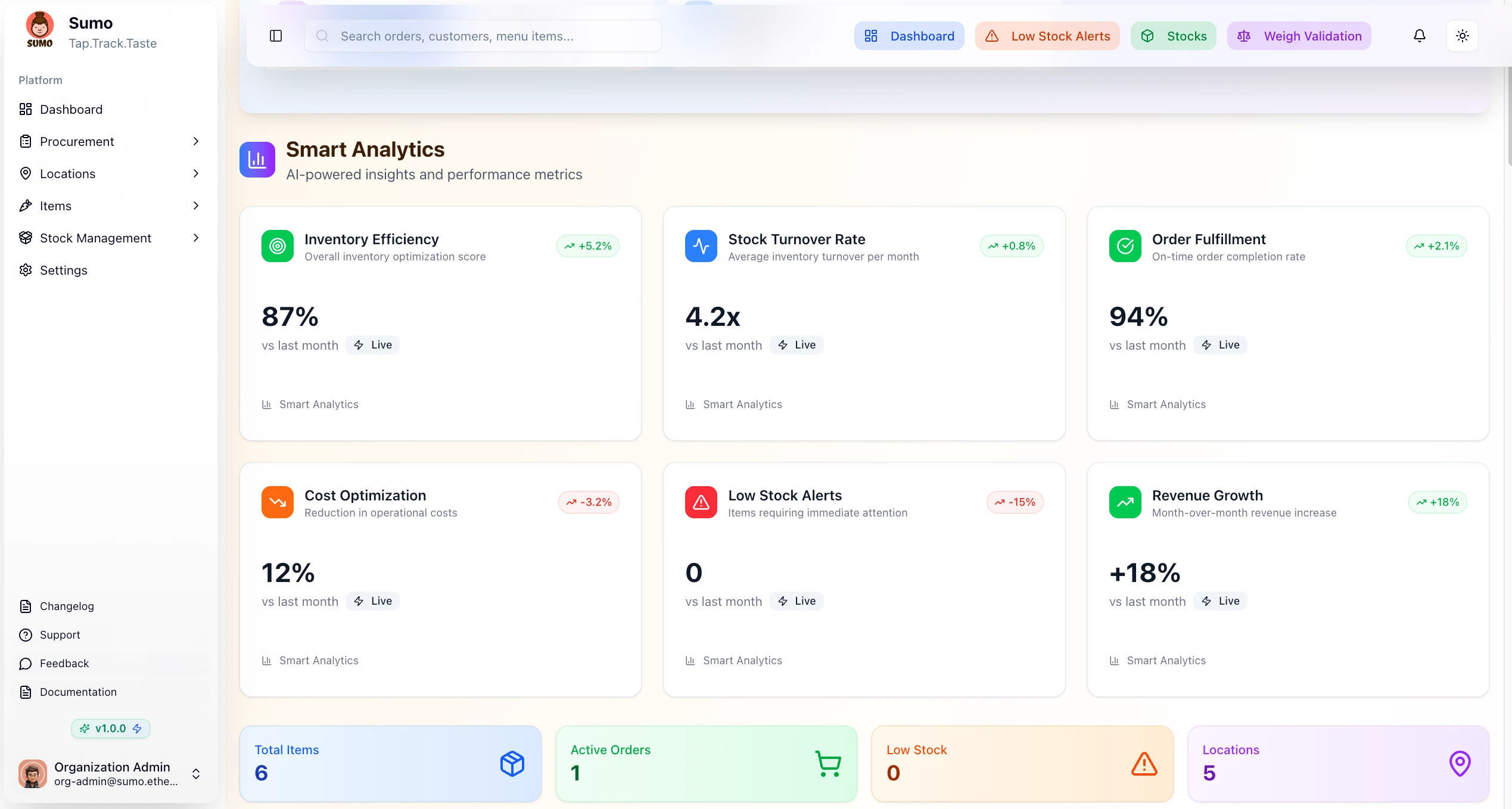
At a glance
The numbers
~40K
meals processed per day at peak
~90%
fewer billing & queue errors
17
enterprise sites live
The story
What happened, why, and what moved
Context
I owned product strategy and rollout for Sumo — a smart-restaurant platform built for environments where volume is brutal and margins are thin: university canteens, factory cafeterias, and a national telco's inventory floor. My mandate was end-to-end: define the wedge, sequence enterprise deployments, and own the metrics that proved the system worked on a real lunch line — not in a demo kitchen. The job wasn't to ship another POS. It was to stop money leaking at every seam.
The trap
High-volume kitchens ran on disconnected parts: a POS here, a manual weigh station there, cameras nobody watched, inventory reconciled on paper at close. Billing errors, waste, theft, and queues out the door were treated as the cost of doing business. At thousands of meals a day, a 2% error rate isn't a rounding error — it's a budget line. Leadership knew they were losing money; they couldn't see where. Floor staff knew the systems were wrong; they kept paper backups because they didn't trust the screen.
The bet
I scoped Sumo as a single nervous system — POS, CC cameras, digital weigh machines, and conveyor belts wired into one AI-watched platform. The wedge wasn't "more integrations." It was one workflow simple enough that a busy line cook would actually use it. Each deployment site had to become proof for the next. I sized the prize before we expanded features: fewer billing errors, less waste, faster throughput. Every spec tied back to a number the ops team already cared about.
The fight
IoT in the real world is brutal — a scale that drifts, a camera that drops, a belt that jams at lunch rush. Every stakeholder lobbied for their feature; I held the line on reliability before breadth. The war wasn't the hardware demo. It was making the system trustworthy enough that staff abandoned their paper backup. We ran site-by-site rollouts, fixed drift and downtime at each location, and refused to expand until daily active use on the floor was real — not signed off in a conference room.
The proof
We deployed across 3 large universities, 2 manufacturing organizations, and the biggest telco inventory floor in the market — 17 enterprise sites total. Once staff trusted the system, the numbers followed: ~40,000 meals/day processed at peak, billing and queue errors down ~90%, food waste down ~25%. The metric I watched closest was adoption — speed followed trust, not the other way around.
What I'd do again
I'd still start with one site, one rush hour, one workflow — and make that perfect before the roadmap meeting. Enterprise buyers want breadth; floor staff want something that works when the queue is out the door. I'd also instrument distrust earlier: how often did staff reach for paper? That signal predicted success better than any pilot survey.
Product calls
Key decisions
One nervous system, not four integrations
I rejected a best-of-breed stack in favor of one platform where POS, weigh, camera, and conveyor data reconciled in real time. Integration depth mattered less than a single source of truth the floor could trust.
Reliability before features
We sequenced rollout site-by-site, fixing drift, downtime, and lunch-rush failures before expanding scope. Adoption on a busy line beat feature count every time.
Site proof before national narrative
Each cohort had to hit adoption targets before the next site signed. That slowed sales on paper and accelerated trust in deployment — the right trade-off for IoT.
Outcomes
Measured impact
~90% fewer billing & queue errors
After staff abandoned paper backups and trusted the unified flow
~25% less food waste
AI-watched weigh and conveyor flows caught variance before close
17 enterprise deployments
Universities, manufacturing floors, and telco inventory operations
~40K meals/day
Peak throughput across live sites
Takeaways
What I learned
- 1The flashy part was the hardware. The real moat was a workflow simple enough that a busy line cook would actually use it.
- 2Adoption beats integration every time — especially when the user is standing in a rush-hour queue.
- 3If the floor still has a paper backup, you haven't shipped a product yet. You've shipped a demo.
Technical appendix▼
Architecture
Technologies
Related topics
Browse all 16 case studies across AI, commerce, and operations.