Case study · EdTech · AI learning
Mave LMS: AI that builds the course, not just the quiz
An AI LMS that auto-generates learning paths, scripts, and videos — and moved completion up 40% while dropout fell 25%.
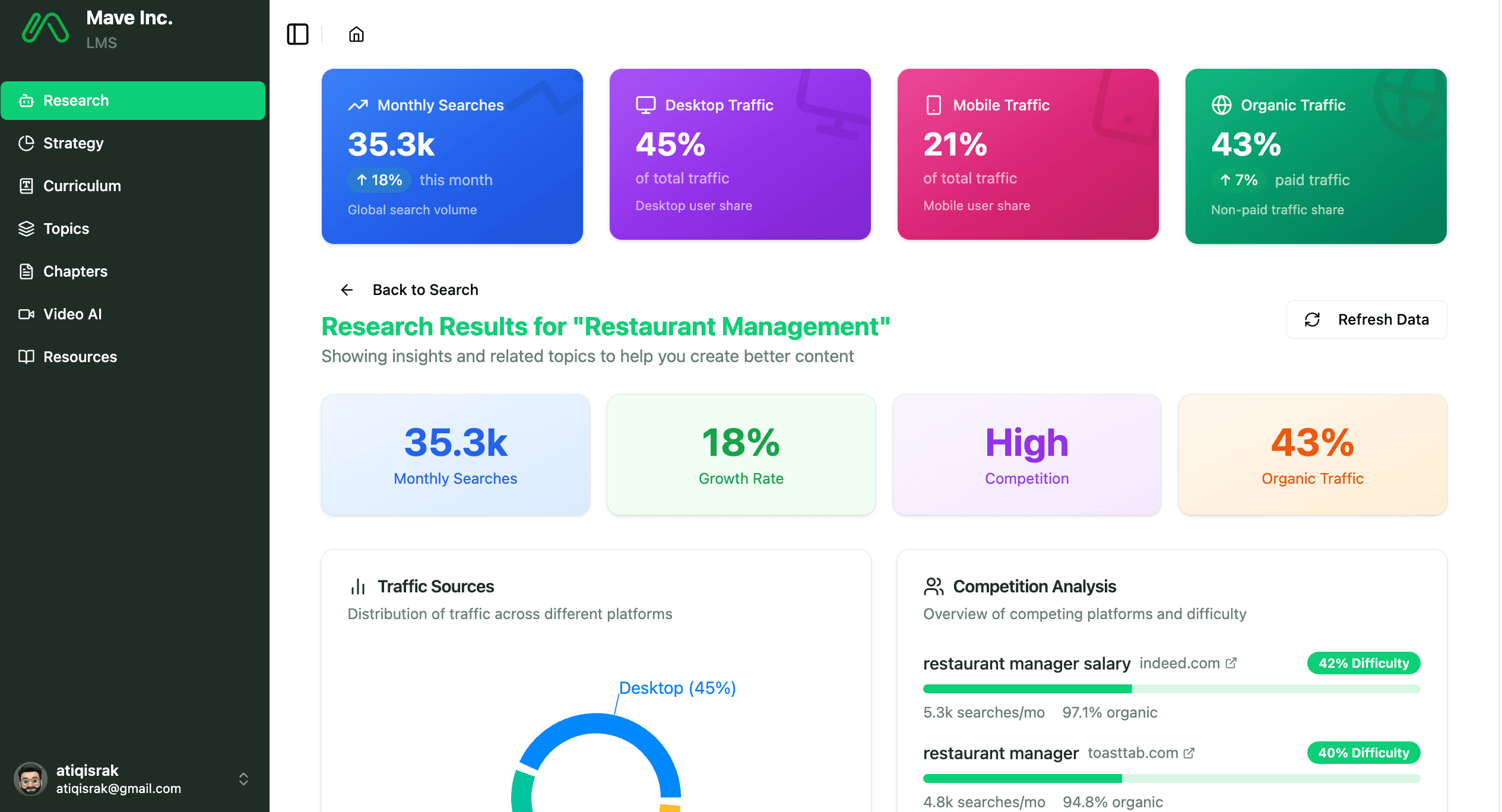
At a glance
The numbers
40%
course completion increase
25%
dropout reduction
90%
engagement on AI-assisted flows
The story
What happened, why, and what moved
Context
I led Mave LMS from wedge definition through learner outcomes — an AI platform that auto-builds learning paths, scripts, and videos and manages students end to end. Traditional LMS products digitize courses; I scoped Mave to reduce the cost of creating and completing them. My north stars were completion and dropout — not feature parity with incumbents. If instructors couldn't produce content faster and learners didn't finish more often, we hadn't built anything new.
The trap
Traditional learning platforms couldn't personalize at scale without armies of instructional designers. Completion rates were flat; dropouts were treated as inevitable. AI was either a gimmick (chatbot tutor) or a black box nobody trusted. Instructors spent weeks assembling modules; learners bounced when content felt generic. The trap was bolting AI onto a content repository and calling it innovation.
The bet
I bet on AI where it removed creation friction and improved completion — auto-generated paths, scripts, and video modules tied to measurable learner outcomes. The wedge: instructors spend time teaching, not assembling content. We held back features that didn't move completion or dropout, even when they demoed well in sales calls. Grading automation, proctoring, social feeds — all waited.
The fight
Every stakeholder wanted AI everywhere at once. I prioritized the creation-to-completion loop first: generate → assign → complete → measure. Without that loop retaining, nothing else mattered. We tested with real cohorts, not pilot slides. Dropout spikes after module three told us more than any roadmap workshop. I cut modules that looked polished but didn't move completion.
The proof
Course completion rose 40%. Dropout fell 25%. Engagement on AI-assisted flows hit 90%. The platform managed the full student lifecycle from enrollment through completion — not just content hosting. Instructors reported spending less time on assembly and more on facilitation — exactly the trade we designed for.
What I'd do again
I'd publish completion and dropout targets on the roadmap doc itself — visible to sales and engineering. EdTech products die when demos win and cohort data loses. I'd also ship instructor tooling before learner personalization. No personalized path matters if there's nothing worth finishing.
Product calls
Key decisions
Completion over feature breadth
I scoped AI to the creation-to-completion loop first. Features that didn't move completion or dropout waited — no exceptions for flashy demos.
End-to-end student lifecycle
Enrollment through completion in one platform — not another content repository with AI bolted on.
Cohort data over opinions
Roadmap calls used dropout curves and module-level completion, not stakeholder loudest voice.
Outcomes
Measured impact
40% completion increase
AI-generated paths and modules reduced friction to finish
25% dropout reduction
Adaptive flows kept learners progressing past early drop-off points
90% engagement
On AI-assisted course flows vs. static content baselines
Takeaways
What I learned
- 1In edtech, AI that demos well isn't AI that completes courses. Measure completion, not demos.
- 2Reduce instructor creation cost first — personalization follows content that actually exists.
- 3Dropout curves are the most honest roadmap review you'll ever have.
Technical appendix▼
Architecture
Technologies
Browse all 16 case studies across AI, commerce, and operations.